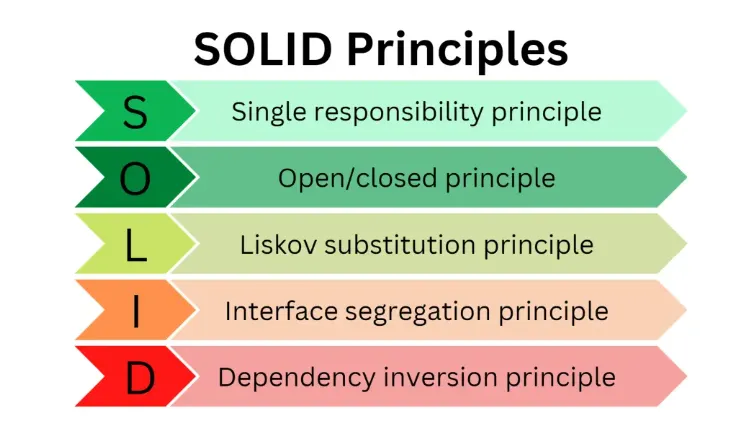

If you’re preparing for software engineering interviews, at some point you’ll be asked:
“Can you explain S.O.L.I.D. principles?”
This question is not about memorization.
👉 It’s about how you design systems, write maintainable code, and think as an engineer.
🚀 What is S.O.L.I.D.?
S.O.L.I.D. is a set of five design principles introduced by Robert C. Martin.
These principles help you build:
- Maintainable code
- Scalable systems
- Flexible architectures
🔑 Why S.O.L.I.D. Matters in Interviews
Interviewers use S.O.L.I.D. to evaluate:
- Your code design skills
- Your ability to scale systems
- Your understanding of clean architecture
👉 It’s a strong signal of mid → senior level thinking
🧩 The 5 Principles Explained (With Real Insight)
1️⃣ Single Responsibility Principle (SRP)
A class should have only one reason to change
🧠 What it means
Each class should focus on one responsibility only.
❌ Bad Example
A single class handling:
- Business logic
- Database operations
- Logging
✅ Good Example
Split into:
- Service layer
- Repository layer
- Logger
💡 Why it matters
- Easier to maintain
- Easier to test
- Fewer side effects
2️⃣ Open/Closed Principle (OCP)
Code should be open for extension, closed for modification
🧠 What it means
You should be able to add new behavior without modifying existing code.
❌ Bad Example
if payment_type == "card":
    ...
elif payment_type == "paypal":
    ...
✅ Better Approach
Use polymorphism:
class Payment:
    def pay(self):
        pass
💡 Why it matters
- Reduces bugs
- Improves scalability
- Encourages clean design
3️⃣ Liskov Substitution Principle (LSP)
Subtypes must be replaceable for their base types
🧠 What it means
A child class should behave correctly when used as its parent.
⚠️ Classic Problem
A Square inheriting from Rectangle can break logic.
💡 Why it matters
- Prevents unexpected behavior
- Ensures correct inheritance
4️⃣ Interface Segregation Principle (ISP)
Don’t force classes to implement methods they don’t use
🧠 What it means
Use small, focused interfaces.
❌ Bad Example
class Worker:
    def work(self): pass
    def eat(self): pass
👉 What if it’s a robot?
✅ Better Approach
Split interfaces:
- Workable
- Eatable
💡 Why it matters
- Cleaner code
- Better flexibility
- Easier maintenance
5️⃣ Dependency Inversion Principle (DIP)
Depend on abstractions, not concrete implementations
🧠 What it means
High-level modules should not depend on low-level modules.
❌ Bad Example
class OrderService:
    def __init__(self):
        self.db = MySQL()
✅ Better Approach
class OrderService:
    def __init__(self, db):
        self.db = db
💡 Why it matters
- Enables testing (mocking)
- Reduces coupling
- Improves flexibility
🧠 How to Explain S.O.L.I.D. in an Interview
🎯 Best Structure
- Start with a high-level definition
- Explain each principle briefly
- Give a real-world example
- Mention benefits
💬 Example Answer
“S.O.L.I.D. principles help design maintainable and scalable systems. For example, I apply SRP by separating business logic from persistence layers, which improves testability and reduces coupling.”
⚠️ Common Mistakes
- ❌ Memorizing definitions only
- ❌ No real-world examples
- ❌ Over-engineering everything
- ❌ Ignoring trade-offs
🎯 Key Takeaways
- S.O.L.I.D. = clean, scalable design
- Focus on:
- Separation of concerns
- Loose coupling
- Flexibility
- Always connect theory to real experience
🚀 Final Thoughts
S.O.L.I.D. is not just for interviews.
It’s a mindset that will make you a better engineer long-term.
🔥 Pro Tip
If you want to stand out in interviews:
👉 Connect S.O.L.I.D. with:
- Dependency Injection
- Testing
- Microservices architecture